

I revisited Beethoven’s Piano Sonata No. 26 in preparation for burning my fourth CD.
Composed in 1809, the work is closely connected to the Austrian campaign that broke out in Central Europe.
Beethoven wrote the three movements as a musical depiction of his pupil, Archduke Rudolph, evacuating from Vienna during the war and later returning home.
This latest revision required a great deal of detailed work—redoing the sound of each note with far more care.
As my advisor always says, “Every single connection between notes has meaning.”
The most difficult part to get approved was Beethoven’s own inscription at the opening: Le – be – wohl, meaning “farewell” in German.
It is written almost like lyrics above the descending motives G–F–E♭ and E♭–B♭–G, which form three successive chords.
According to my advisor, this is the thematic core of the entire sonata.
In Beethoven’s autograph, each syllable is divided with hyphens—Le (“you”), be (“may it be”), wohl (“well,” “safe”),—the phrasing intended, it seems, to emphasize the emotional weight of each word.
However, for some reason, the Henle edition I am using presents it in the following way:
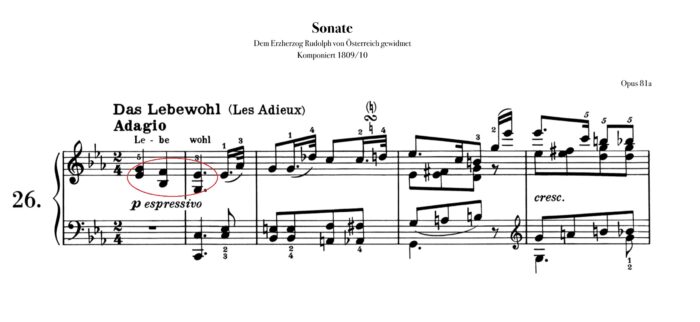
At first I didn’t notice it myself, but it appears that Beethoven constructed this sonata from several such characteristic motifs. He tells me this represents a new and experimental approach for Beethoven.
Song Title:
Title:.
Piano Sonata No. 26 in E-flat Major, Op. 81a, “Farewell”
Sound source:
Sound Library:
Synchron Concert D-274
Audio file format: mp3
For streaming on a PC, please see this page.
Here
See 。
For streaming on a PC, please see
this page.