

— From “a Gentle Breeze Across a Meadow” to an Ensemble of Four Tautly Interacting Strings —
When I previously revised Beethoven’s String Quartet No. 13, Op. 130, fifth movement, “Cavatina” [1], I used Vienna MIR Pro 3D [2] for the first time.
As an initial reference, I turned to the YouTube video published by Vienna Symphonic Library, “Vienna MIR Pro 3D – Tutorial with Real String Quartet” [3].
Using a real string quartet, the video demonstrates how the sound changes with different placements and Dry/Wet settings in several venues, including the Mozartsaal. It was extremely helpful when I first started using MIR Pro 3D.
[1] Beethoven String Quartet No. 13-5 “Cavatina” (Revised)
[3] Vienna MIR Pro 3D – Tutorial with a Real String Quartet (Vienna Symphonic Library)
MIR Pro 3D was a plug-in I had long wanted to use. While I found basic explanations and orchestral examples, surprisingly, apart from this tutorial video, I could find very few detailed practical examples specifically for string quarte
So I decided to revisit the setup and document it here, both as a reference for my own future work and as one practical example of how MIR Pro 3D can be configured for a string quartet.
1. The Starting Point — Beautiful Sound, but………
I use the traditional seating order:
Vln1 – Viola – Cello – Vln2
At first, I created my MIR Pro 3D setup while referring to the Vienna tutorial mentioned above.
The result was beautiful, and the four strings blended very well. I was also greatly impressed by the acoustic character of the Mozartsaal.
However, after listening several times, I gradually began to feel that it sounded simply like “a gentle breeze blowing across a meadow.”
Beautiful, yes — but perhaps a little too gentle.
There was certainly the quiet beauty appropriate to the Cavatina, but I felt that the characteristic interaction of a string quartet was too weak: four players listening to one another, reacting, and at times creating tension between themselves.
Of course, this does not mean that there is anything wrong with the setup shown in Vienna’s tutorial. The video was extremely helpful in understanding how to place a real quartet naturally within the acoustic space of MIR Pro 3D.
What I wanted from Beethoven’s Cavatina, however, was not simply a “beautiful space” created by separating the four strings. I wanted to go one step further and create a convincing sense of tension and interaction among four individual players.
So, as a relative newcomer to MIR, I decided to rethink the setup from the ground up and learn more about this remarkable plug-in. The specific settings and values are listed below.
2. Initial MIR Setup — MIR1
Venue: Mozartsaal
Seating Order: Violin 1 – Viola – Cello – Violin 2
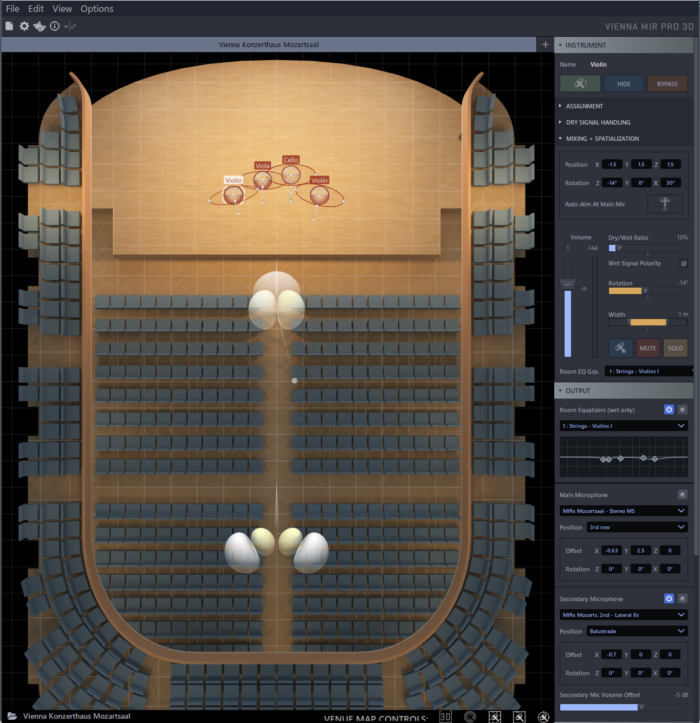
Vln1
・Position: x=-1.5, y=1.5, z=1.5
・Rotation: z=-14, y=0, x=30
・Width: 1.0
・Dry/Wet: 10%
Viola
・Position: x=-0.5, y=2.2, z=1.5
・Rotation: z=0, y=0, x=15
・Width: 1.0
・Dry/Wet: 20%
Cello
・Position: x=0.5, y=2.2, z=1.5
・Rotation: z=0, y=0, x=-15
・Width: 1.0
・Dry/Wet: 20%
Vln2
・Position: x=1.5, y=1.5, z=1.5
・Rotation: z=14, y=0, x=-30
・Width: 1.0
・Dry/Wet: 10%
Main Microphone
・MIRx Mozartsaal – Stereo MS
・Seat: 3rd Row
・Offset: default
Secondary Microphone
・MIRx Mozartsaal 2nd – Lateral 8s
・Position: Balustrade
・Offset: default
・Volume Offset: -5 dB
Auto-Aim: Off
The orientation of each instrument is set individually.
Instrument Profile:
Set the appropriate settings for each instrument
3. Rethinking the MIR Setup
I kept the traditional seating order of the four players, but reconsidered the relationships among instrument spacing, horizontal spread, Width, Rotation, and Dry/Wet.
4. Revised MIR Setup — MIR2
Venue: Mozartsaal
Seating Order: Violin 1 – Viola – Cello – Violin 2
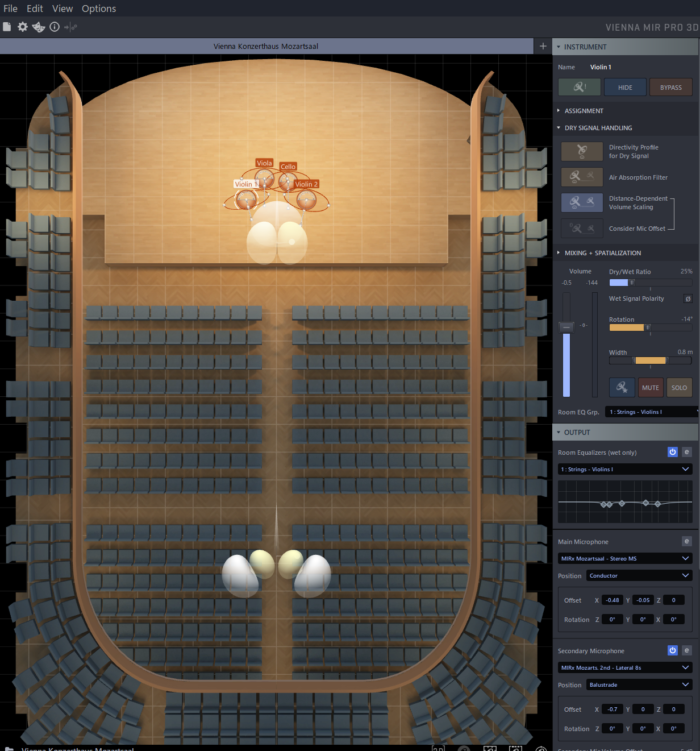
Vln1
・Position: x=-1.0, y=1.5, z=1.5
・Rotation: z=-14, y=0, x=0
・Width: 0.8
・Dry/Wet: 25%
Viola
・Position: x = -0.4, y = 2.2, z = 1.5
・Rotation: z=0, y=0, x=0
・Width: 0.8
・Dry/Wet: 30%
Cello
・Position: x=0.4, y=2.3, z=0.8
・Rotation: z=0, y=0, x=0
・Width: 0.8
・Dry/Wet: 25%
Vln2
・Position: x=1.0, y=1.5, z=1.5
・Rotation: z=14, y=0, x=0
・Width: 0.8
・Dry/Wet: 30%
Main Microphone
・MIRx Mozartsaal – Stereo MS
・Position: Conductor
・Offset: default
Secondary Microphone
・MIRx Mozartsaal 2nd – Lateral 8s
・Position: Balustrade
・Offset: default
・Volume Offset: -5 dB
Auto-Aim: Off
The orientation of each instrument is set individually.
Instrument Profile:
Set the appropriate settings for each instrument.
Compared with MIR1, the four players in MIR2 were moved slightly closer toward the center, and Width was reduced from 1.0 to 0.8. I also removed the X-axis Rotation and simplified the setup so that the horizontal Z Rotation became the main directional adjustment.
I also compared the Dry/Wet balance again and eventually settled on:
Vln1 25% / Viola 30% / Cello 25% / Vln2 30%
Naturally, the further the balance is shifted toward Dry, the more clearly each individual string stands out. These values were chosen as the point at which the direct sound retained sufficient clarity while the four instruments still sounded as though they were performing together in the same acoustic space.
5. Changing MIR Also Changed the Performance Balance
With MIR2, the presence of each instrument became clearer, but at the same time, the volume balance I had previously created began to fall apart. I found this particularly interesting.
Even though I had intended only to change the spatial setup, the perceived relationship among the four voices changed as well, which meant that the performance itself had to be adjusted again.
I first reconsidered the balance of Vln2, Viola, and Cello, and then went back through the piece from the beginning to revise CC11.
I also changed the Body IR settings so that Vln1 and Vln2 would sound not simply like two parts played by the same virtual instrument, but more like two individual violins.
・Vln1: S6
・Vln2: S1
In addition, I applied only a very small amount of EQ to Vln1 so that it would separate from Vln2 by just “half a step,” so to speak.
FabFilter Pro-Q 4
・Filter: Bell
・Frequency: 1500 Hz
・Gain: +1.0 dB
・Q: 0.8
At first, I was simply impressed by the beautiful acoustic space created by the Mozartsaal in MIR Pro 3D.
But as I pursued that beauty, I came to realize that the individual strings lacked a certain degree of tension, and that the relationship among the four players needed to become more convincing.
When you think about it, that is really one of the fundamentals of string quartet playing.
So, in the end, this became a process of moving from the beautiful sound of “a gentle breeze blowing across a meadow” toward a string quartet in which four strings each retain their own tension while constantly listening and responding to one another.
This MIR2 setup now seems likely to become my basic starting point whenever I work on other string quartets in the future.