

While working on a MIDI performance of the opening of the third movement of Beethoven’s String Quartet No. 15, there was one thing that kept bothering me: that remarkable non-vibrato passage at the beginning.
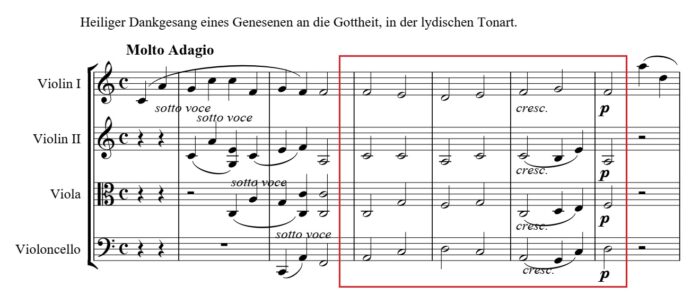
When those long chords were sustained, I could never quite achieve the natural resonance of a real string quartet. There was always a faint sense of beating or wavering in the sound.
I tried adjusting the CC11 curves, the amount of vibrato, and the balance between the four voices again and again, hoping to make the resonance as natural as possible. Even so, my teacher commented, “There’s still a faint trembling in the sound. Can’t you do something about it?” That left me wondering what else I could try.
Listening to various great performances, I am always struck by the transparency and extraordinary stability of this passage. The four players keep vibrato to an absolute minimum and sustain these long chords at an extremely soft dynamic, yet the sound remains remarkably clear and steady.
Here, even tiny differences in pitch can become audible. And if the volume or tone color of the four instruments changes independently, the chord itself can seem to waver. I imagine this must be an extremely demanding passage for the performers as well.
This time, in creating the MIDI performance, I tried two approaches that were somewhat different from what I had done before.
One was to introduce dynamically adjusted pitch relationships closer to just intonation. The other was to make the changes in volume of the individual instruments relate more closely to one another.
One is to correlate the volume changes of each instrument as much as possible. The other is to dynamically incorporate pitch relationships that are close to just intonation.
In MIDI programming, if the CC11 curves of the four instruments move independently, the balance among the four voices continues to shift subtly even during a long non-vibrato chord. So, while keeping the actual volume of each instrument different, I tried to make the overall shapes of their long-note swells and decays more similar. Surprisingly, this also proved quite effective in making the chords sound more stable.
Here, however, I would like to concentrate on the first approach: introducing pitch relationships closer to just intonation.
In a real string quartet, the players constantly listen to one another and often make tiny adjustments to their intonation so that a chord resonates as naturally as possible. With MIDI and software instruments, however, the pitches normally follow whatever tuning system has been set in the instrument.
Some software instruments allow you to choose equal temperament, just intonation, Pythagorean tuning, and so on. But a fixed tuning system cannot always accommodate modulations and changing harmonic relationships. It is also possible to adjust individual pitches with pitch bend, but doing this for all four voices of a string quartet soon becomes rather cumbersome.
So this time I decided to seriously try Hermode Tuning, a feature that has actually been available in Cubase Pro for quite some time.
The result was rather impressive.
After listening to the new version, my teacher jokingly remarked, “The previous one sounded like an amateur string quartet somewhere in the Japanese countryside. This one sounds more like the Vienna Konzerthaus Quartet in its prime.”
Of course, that was deliberately exaggerated, but I think it shows just how much the relationship among the four voices—and the overall character of the harmony—had changed.
What Is Hermode Tuning in Cubase Pro?
Hermode Tuning analyzes the relationships among the notes sounding during a performance and dynamically adjusts individual pitches so that the harmony can resonate more naturally.
Intervals such as thirds and fifths, which in equal temperament differ slightly from pure integer-ratio intervals, can be adjusted toward purer relationships.
Unlike a fixed tuning system in which each note name is assigned a predetermined correction, Hermode Tuning can alter the amount of correction according to the harmonic context of the note.
Below, I have summarized the basic mechanism of Hermode Tuning and how I set it up in Cubase.
Tha Experiment
For this experiment I used the third movement of Beethoven’s String Quartet No. 15 in A minor, Op. 132, which I am currently programming.
After coordinating the CC11 volume changes of the four instruments as closely as possible, I compared the opening passage in particular.
This passage provides unusually good conditions for hearing the effect of Hermode Tuning: predominantly non-vibrato playing, long sustained notes, quiet chorale-like writing, and closely related four-part harmony.
Settings in Cubase Pro
Hermode Tuning can be found under Project → Project Setup.
Mode: Classic (pure 3/5 equalized)
Depth: 100%
A depth of 100% is quite an extreme setting, but in this particular passage I found the improvement in harmonic cohesion much more noticeable than any unnatural change in pitch.
Depth: 0%
Audio Source: SCES
Depth: 100%
Audio Source: SCES
Note 1: Both audio examples were rendered from exactly the same MIDI data. Only the Hermode Tuning Depth setting was changed.
note (supplementary information) symbolNote 2: SCES = Solo, Chamber & Ensemble Strings (Samplemodeling).
My First Impressions
The first thing I noticed was that the beating or wavering in the harmony that had been bothering me was greatly reduced.
It was not so much that the tone color itself had changed. Rather, the four notes that had previously seemed to interfere slightly with one another now seemed to settle naturally together into a single chord. The non-vibrato sonority that I had struggled with for so long became considerably calmer and more stable.
I also felt that the inner voices—the second violin and viola—seemed to find their natural place within the harmony, even though I had not increased their volume.
Reference: How Hermode Tuning Works
Hermode Tuning is a system that dynamically adjusts the fixed tuning of electronic instruments and software instruments according to the harmony being played. The system was developed by the German Werner Mohrlok. (See the references below.)
1. It Is Different from Fixed Just Intonation
If just intonation is applied as a fixed tuning system to an entire instrument, it may sound beautiful in one key or chord, but modulation and harmonic progression can create problems with other interval relationships.
Hermode Tuning continuously analyzes the relationships among the notes being played and changes the amount of pitch correction as the harmony changes.
This makes it better suited than fixed microtuning to music containing modulation and changing harmonic progressions.
2. What Does “pure 3/5” Mean?
The “3/5” in the Cubase mode name refers to thirds and fifths.
For example, in a C–E–G chord, intervals such as the third C–E and the fifth C–G are adjusted toward purer interval relationships.
The mode I used here, Classic (pure 3/5 equalized), attempts to bring thirds and fifths as close as possible to pure interval relationships while also preventing the overall pitch from gradually drifting in one direction.
3. Additional Track Settings Are Required
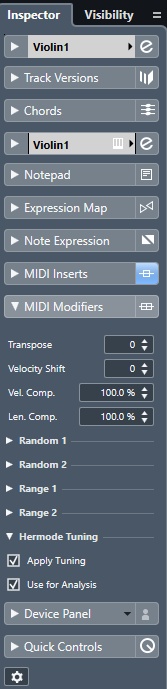
After selecting the Hermode Tuning mode and Depth in the Project Setup, Hermode Tuning must also be enabled for the instrument tracks involved.
In Cubase Pro 11, open “MIDI Modifiers” → “Hermode Tuning” in the Inspector for each track, and check the boxes for “Apply Tuning” and “Use for Analysis.”
The note information from tracks with Use for Analysis enabled is used to determine the harmony currently sounding. The calculated pitch corrections are then applied to tracks for which Apply Tuning is enabled.
For this string quartet, I enabled both options for the first violin, second violin, viola, and cello tracks.
Dynamic pitch correction with Hermode Tuning also depends on support from the software instrument being used. With VST3 instruments, it can be used with instruments that support Micro Tuning and Note Expression.
4. Individual Notes Are Adjusted Separately
Hermode Tuning does not simply raise or lower an entire chord by the same amount. Instead, it analyzes the relationships among the notes sounding at a particular moment and applies the necessary pitch correction to individual notes.
This means that even the same E, for example, will not necessarily receive the same amount of correction if the surrounding harmony or the other notes sounding at the same time have changed.
This is one of the major differences between Hermode Tuning and a fixed microtuning system in which predetermined corrections are assigned to individual note names.
Being able to introduce purer interval relationships dynamically into music with changing harmony seems to me to offer considerable possibilities for digital classical performance—not merely as a tuning function, but as part of the expressive shaping of an ensemble.
References
Hermode Tuning Official Website
Cubase Pro Operation Manual ― Hermode Tuning